Blog › Lifestyle changes and HbA1c improvement in type 2 diabetes › When Small Changes Show Up in HbA1c

When Small Changes Show Up in HbA1c
One clinician’s practice pattern raises a useful question about walking, diet, and blood glucose control—without proving which made the difference.
Can a morning walk and a smaller evening rice portion move HbA1c when the medication stays the same?
The numbers moved
An adult with type 2 diabetes had an HbA1c of 8.6%. Metformin was unchanged.
The patient then began a 30-minute morning walk and reduced the evening rice portion by half. At follow-up, HbA1c was 7.8%.
No new drug had been added.
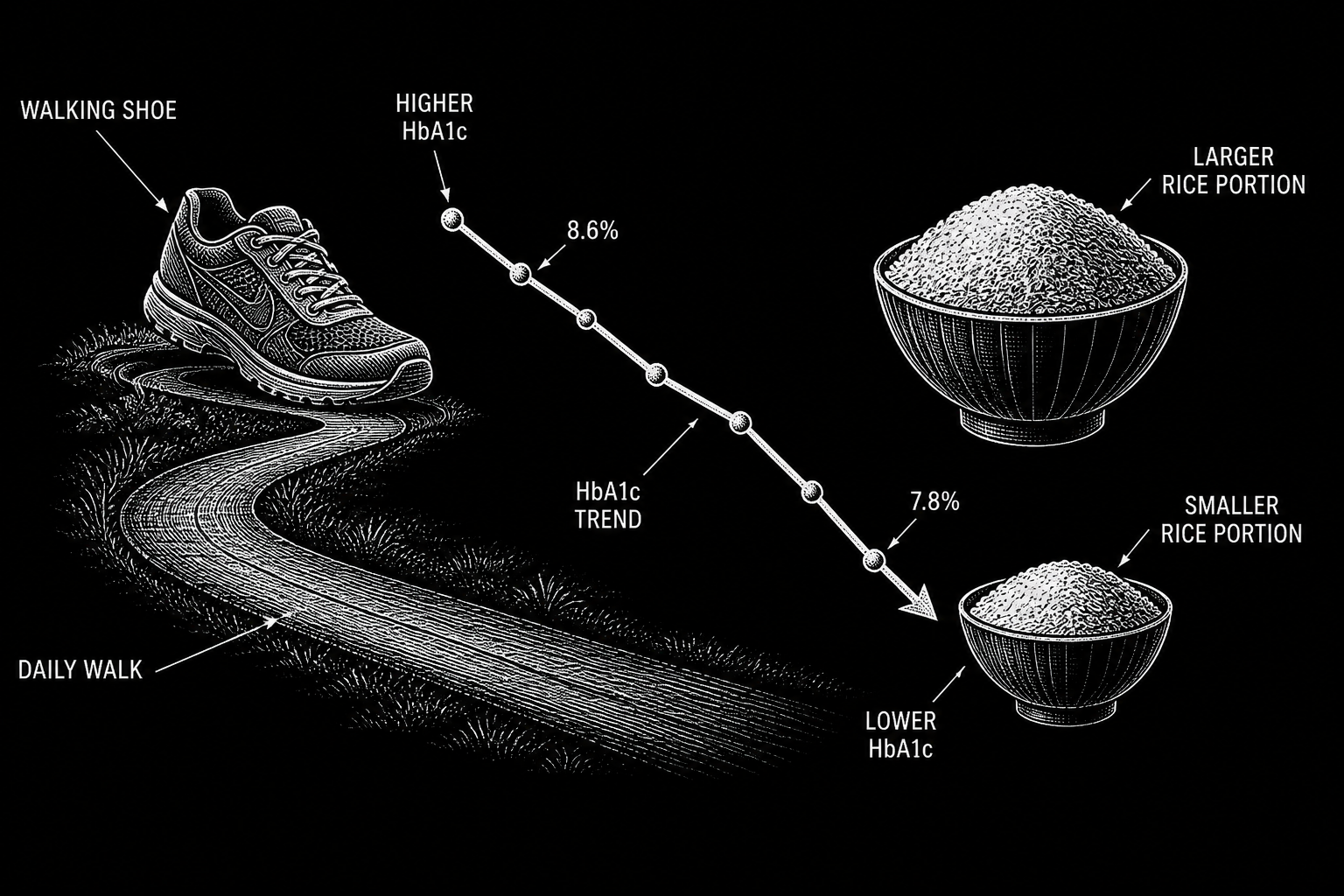
One change, two possibilities
The patient felt the walk had contributed more than the dietary change. That is an important part of the account—but it is still an individual impression, not a way to separate the effects of the two changes.
Both happened in the same period. Other influences may have mattered as well.
A measurable change is not the same as a proven cause.
What the pattern suggests
The difference was 0.8 percentage points, alongside unchanged metformin and the two lifestyle adjustments.
In isolation, this is one observation. It does not establish that walking alone, reducing rice alone, or either change by itself caused the HbA1c improvement.
A repeated practice signal
The clinician has observed a similar improvement in three patients this year after lifestyle changes without added medication. That repetition makes the pattern worth noticing.
It still does not answer the central question: how much came from walking, how much from dietary change, and how much from factors not captured here?
Repeated observations can sharpen a question before they can settle it.
What to watch next
The useful lesson is not that one routine will work in the same way for everyone. It is that small, practical changes may coincide with a meaningful shift in HbA1c, even when medication has not changed.
The next step in thinking is to pay attention to the pattern without turning it into a promise.
What would we learn if these changes were followed more systematically?
Key takeaway
In this clinician’s practice, several adults with type 2 diabetes appeared to improve their HbA1c after lifestyle changes without additional medication. One patient’s HbA1c fell from 8.6% to 7.8% after starting a 30-minute morning walk and halving the evening rice portion, but the observation cannot show which change was responsible.